


Last month I reviewed the new Wuthering Heights adaptation — the one that came out on Valentine’s Day, marketed, naturally, as the greatest love story ever told. Regular readers will know I was rooting for Edgar. If you missed it, here’s the piece.
And if you’ve been here a little longer, you’ll know I have a standing problem with borderline-criminal behavior being packaged as romance. I even have a test for it. The Gollum Test: if it only reads as romantic because the man doing it is attractive, it isn’t romance. It’s just a restraining order in a waistcoat.
But I don’t want to be the cranky cat lady who shakes her first at others in perpetual discontent. Anyone can point at the bad example. I want to talk about who got it right.
Fortunately, I didn’t have to look far to do that. Same year. Same family. Different sister. I am talking, of course, about Jane Eyre.
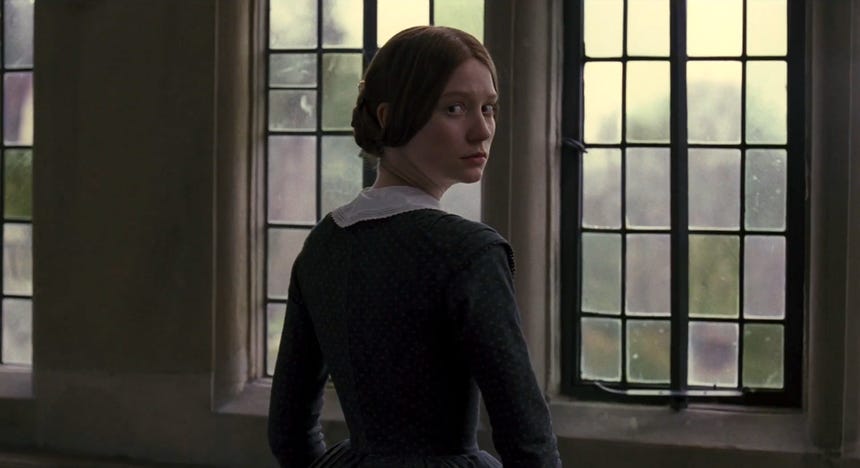
Charlotte Brontë’s novel is equal parts romance and bildungsroman — a coming-of-age story, for the non-Germans among us — with a gothic sprinkle on top, because 1847. Her protagonist is, from page one, fiery, passionate, and headstrong, with a solid sense of self and a thirst for justice. She is, frankly, a badass. Her arc is one of growth and resilience through absolute misery in a very, very male world — and she does come out on top. Just not the way you’d expect.
(SPOILERS) On the surface, it’s Cinderella 101: poor plain girl gets the prince cum mansion in the end. But look closer. One: she’s not rescued by him — in fact, she’s the one who does the rescuing, and is not afraid to leave when his morals turn out to be, er, debatable. Two: she marries him only once she’s become his equal via a handy inheritance, and he’s been taken down a notch or three. Three: the prince is charismatic as hell but described as flat-out ugly on multiple occasions. Because our gal ain’t shallow.
So why is this a great love story? The key word is boundaries. I know — not sexy. But bear with me.
Jane loves Rochester with full knowledge of his flaws, and there are many. She sees him clearly and loves him anyway. But she will not disappear into him or for him. Hence her famous line: “I am a free human being, with an independent will; which I now exert to leave you.”

She will follow him, she says — in all that is right. Not unconditionally. Within her values, on her terms.
Wuthering Heights, by contrast, is where boundaries go to die. Catherine famously says “I am Heathcliff.” Heathcliff, after her death, cries “I cannot live without my life.” Their love is a black hole, a huge dark nothingness that destroys them and everything around them — as the novel’s architecture makes clear, because nobody, and I mean nobody, ends well.
Incidentally, Heathcliff fails the Gollum Test. Spectacularly. Yes, Rochester flirts with a woman he has no intention of marrying, just to see if Jane is reciprocating his feelings. Not ideal, I’ll grant you. But Heathcliff? He does marry a woman to spite Cathrine, and hangs his poor bride’s dog for good measure. Let me say that again: he hangs her dog.
Why we decided that’s romantic is genuinely beyond me.
To be clear, this is not a flaw in the novel. It is the novel’s argument. Emily Brontë was not writing a love story. She was writing a case study in what happens when two people with no sense of self decide that the solution is to become one person.
The novel’s genuine psychological insight — and it is a dark one — is that what Heathcliff calls love is not distinguishable from hate.
Jane Eyre understood something Wuthering Heights spends four hundred pages proving by catastrophic counterexample: love without a self isn’t love.