


Like many others, I went to see the controversial new version of Wuthering Heights the other day. People seem to love it or hate it. Here’s my take. (I will not draw comparisons with the novel, because if you catalogue all the bits that were left out or changed, you’ll just make yourself upset and nobody needs that kind of afternoon.)
The “vibe” of the film is captured in the opening minutes, before you even see anything, as the title credits roll. You hear a man grunting—louder and louder—accompanied by the rhythmic creaking sound that inevitably makes you think of a bed. Someone’s getting naughty, you think, bracing yourself for a Georgian sex scene where the man’s about to climax and the woman’s just… taking it. Because we hear no female sounds.
And yet.
What we see is a man being hanged. He takes a very long time to die and, true to grim biological reality, gets the proverbial hard-on in the process.
“Oh, I get it,” you think. “Sex and death. Eros and Thanatos. Very clever.”
And that’s kind of how the entire film continues.
The symbolism is heavy-handed in a way that makes you feel like you’re being lectured by a particularly earnest film student. Cathy is always wearing red—the color of passion, naturally, in case you missed it the first seventeen times. All sensual aspects are drawn attention to with the subtlety of a fire alarm: the wind, the rain (which, to be fair, are also prominent in the novel), but also blood, snails, a fish (?), mud, more blood. At one point I half-expected someone to start eating a pomegranate just to really hammer the point home.
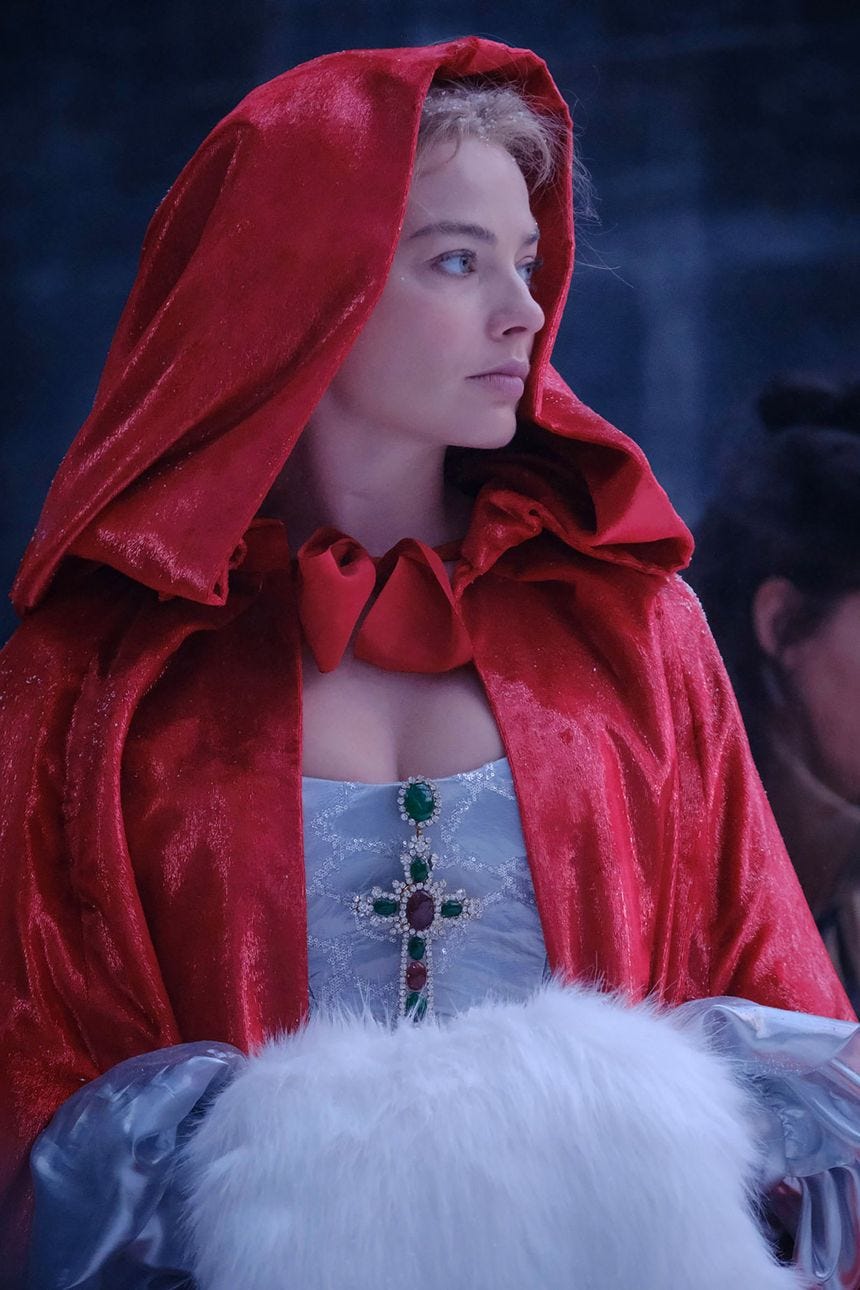
One thing I genuinely appreciated: the film does not romanticize the setting. Contrary to many Jane Austen adaptations where everyone’s hair looks suspiciously clean, here you are constantly reminded of the dirt, the cold, the poverty, and the utter misery of life in the past—unless you were rich, of course, in which case your misery was at least well-upholstered.
Let’s talk about the rich.
The production design for the wealthy characters is so over-the-top it feels like something out of a Lady Gaga music video. The Linton house looks like a literal dollhouse—all shiny surfaces and mannered postures—emphasizing, I suppose, the performativity of the upper class. It’s a choice reminiscent of the 2012 Anna Karenina adaptation, which was literally set on a theatre stage. Daring? Sure. Effective? Debatable.
Here’s the trailer in case you missed it.
The problem is this: the film becomes an intellectual viewing experience rather than an emotional one. As in the novel, neither of the main characters is particularly nice. But the director found a way to villainize even the people who were decent in the book—Nelly the housekeeper and Cathy’s father both come off worse here, which is quite a feat. So what you’re left with is a visually striking exploration of, I guess, the addictive nature of lust. Not love. Lust, as proven by the endless finger licking and tongue sucking.
Interestingly, there are references to Romeo and Juliet that are not present in the original novel—introduced, I suspect, to suggest that these two unhappy lovers are victims of circumstance rather than their own spectacularly poor communication skills.
But are they?
Could Heathcliff and Cathy have been happy if everything had gone well and they’d married in abject poverty? I personally doubt it. I envision a future of domestic abuse, financial ruin, and the kind of misery that makes for a very depressing existence.
So why make it all destiny’s fault?
Perhaps, as others have suggested, this film is meant to capture the look of romance as a genre—romance as an ideal, all shiny colors and dramatic declarations. It’s the kind of thing you might fall for as a teenager, ascribing all problems to external forces like fate or society or the stars. But to the more mature observer, it can’t help but come across as a bit… shallow. Performative, even. Like watching people make silly decisions in slow motion while a very expensive camera captures every drop of bodily fluid involved.
In fact, I was rooting for Edgar the entire time. The only sane character in this film, if you ask me. Loving, patient, not even judgmental despite ample cause—and yet not a doormat either. He’s the adult in a movie full of children throwing tantrums in beautiful costumes.
The film is visually stunning. The performances are committed. The direction is bold. But at the end of the day, I walked out thinking less about doomed love and more about how exhausting it must be to live your entire life at emotional eleven.
Maybe that’s the point.
Or maybe I’m just too old for this kind of romance.