


I watched this video the other day. Jubilee’s “1 vs 20” format — one anti-manosphere guy on one side of the table, twenty manosphere guys on the other, or so I assumed going in. I am, for context, a woman who is very much not pro-manosphere, so I settled in for what I expected to be a comfortable, judgmental hate-watch. Look at these losers. Bring snacks.
To be fair to my own low expectations: some of them delivered spectacularly.
When the question came of just how much a woman’s “body count” matters (in case you’re wondering: her body count, a term I’d hitherto only heard in association with serial murder, apparently means how many people she slept with), this one guy delivered this timeless analogy:
“If we both go to a used car lot, one car is totaled — engine’s blown out twice, head gasket never works. The other car has a fender bender. Which one you taking?”
To my utter shock, this very view, which couches women’s sexual experience as something that a) inherently reduces her value and b) proves she’s basically feral, was reiterated by a woman.
“If something’s used, there’s no value to it. It’s just — I don’t want to be mean, but it’s dirty.” A woman’s body count, in her accounting, is expiry-dated. Somewhere around partner four or five, apparently, you become a fender bender.
That was the first thing I learned from the manosphere. Not all of them are men.
The second thing I learned — and I say this through gritted teeth — is that most of them weren’t quite so medieval in their outlook. Most of them were, infuriatingly, kind of normal. Educated. Coherent. Occasionally, God help me, correct-adjacent.
“I agree that Elizabeth Cady Stanton’s Declaration of Sentiments did not create the [...] problems we have today. First wave, second wave, those secured real rights and freedoms. I think the problem is when you get to third and fourth wave feminism, you get this demoralization of men, this narrative that patriarchy is this overarching thing and men are the primary source of everything wrong with our culture.”
Hate to say it. Maybe he has a teensy-weensy bit of a point.
Watching enough of this video, I started to glimpse a pattern underneath the pattern. Call it the grandfather problem.
These guys grew up watching their fathers — and further back, their grandfathers — run a genuinely simple operation. You got a job. The job got you a house, sometimes two or three. You got married once, ideally to someone who made you dinner and didn’t ask too many questions. By any reasonable measure, that was a very good deal. Then somewhere between their father’s wedding and their own dating-app onboarding, the terms changed and nobody sent the memo. Now there’s a whole taxonomy of genders to learn. You can’t offer to pay for dinner without running a small risk assessment as to whether this will come across as offensive. The woman across the table might very well earn more than you, and not need you in any meaningful way. I understand the vertigo. Losing a bulk of social infrastructure you didn’t know you were relying on will do that to a person.

Here’s where it gets interesting, though, because they are not wrong about the loss.
I can’t personally feel the specific flavor of grievance in that room — the sense that your gender used to come with a set of perks and now it doesn’t (or at least not as much as before). That was never a deal on offer to me, so it’s not one I can mourn. But I know the general shape of the feeling, because I have my own version of it, and so does every millennial regardless of what’s in their pants: watching your parents get handed a version of adulthood that simply is not for sale anymore, at any price, to anyone your age. My generation works considerably harder than our parents’ for a fraction of the house — often none of the house, just a pesky landlord. Why the fuck is it all so hard now, when it so visibly wasn’t for the people who raised us? That question, that feeling of being cheated, I understand in my bones. (I wrote a whole piece — “The Country That Chose People Over Banks” — on this issue.)
So that’s the bridge. Not agreement — God forbid — but a shared feeling, aimed at two different culprits. Because when I go looking for who took the good deal away, I land on the banks, the landlords, an economy that decided a home is an asset class first and a place to live second. When the manosphere goes looking, it lands on feminism. And that’s the part that doesn’t hold up, because the accounting is two entirely separate ledgers: capitalism took something. Feminism gave something back.
Before feminism, a woman’s options were a) one type of life, or b) scandal (if you’re lucky), destitution or death (if you’re not so lucky). After feminism, her options are this life, or several others, none of which get her disowned. If you want the trad-wife version — one house, one husband, one clearly marked lane — it is still on the shelf, fully stocked, no waiting list. What changed is that it stopped being the only shelf in the shop.
In the end, what did I actually learn from the manosphere?
Mostly that oversimplification is the disease, and it is not remotely partisan about who it infects.
There’s a flavor of feminism — you’ve met it, possibly practiced it on a bad week — that meets a man and runs a background check before the handshake. Guilty of patriarchy until proven otherwise, and even then, only on probation. It takes a hundred million individual men with a hundred million individual track records and flattens them into a single standing suspect, which is its own kind of laziness wearing a vigilante costume.
And there’s the manosphere’s mirror version, considerably less self-aware about being a mirror: blame feminism for the rent, for the loneliness, for the fact that dating now apparently requires a small legal team, and prescribe a cure that amounts to a return to the caves.
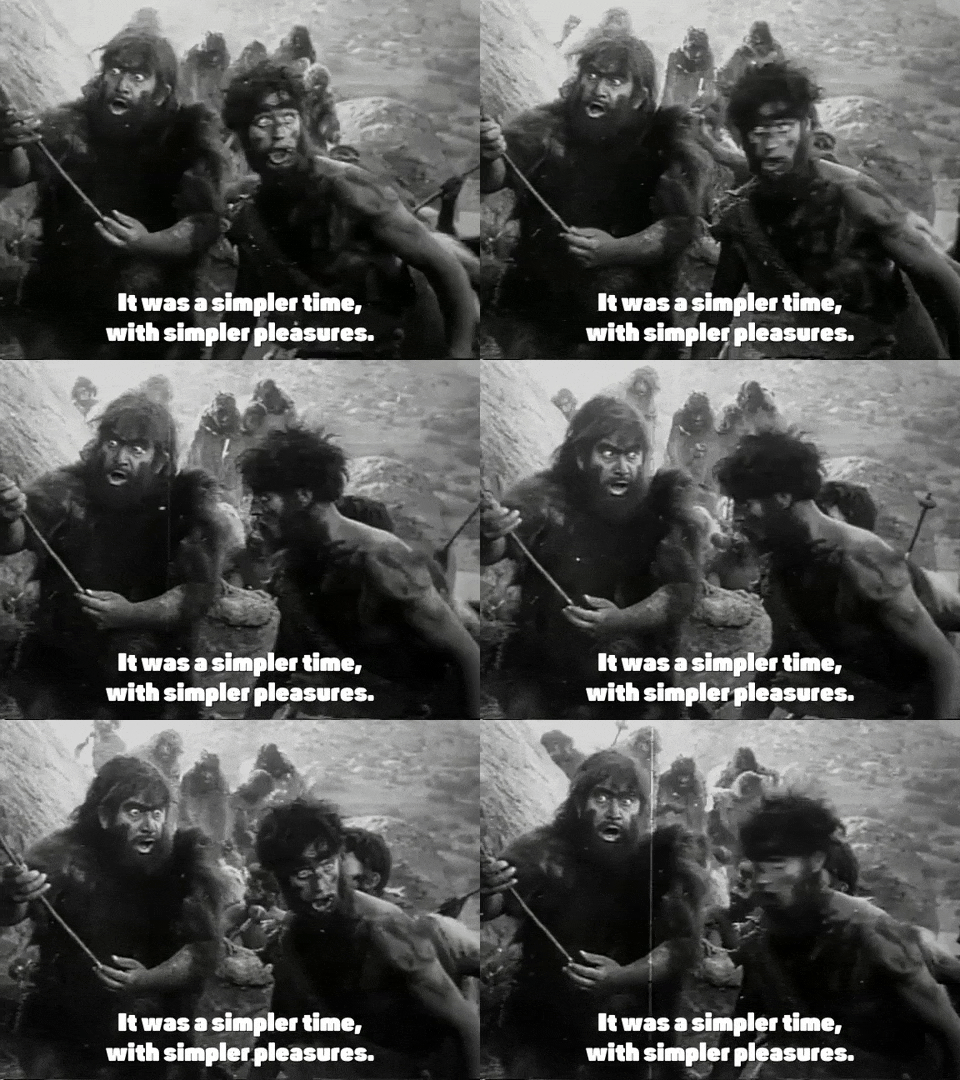
Both camps have found a villain simple enough to explain everything, which is exactly what should make you suspicious of it. Real problems — from the housing market to the dating market — rarely have a single, convenient culprit. The used-car guy, incidentally, was doing the same trick. Sorting the entire female population into two conditions, mint or totaled, because a label is so much easier to live with than a person.
That’s the actual through-line, if you’re after one. Hand anyone a label instead of a deep conversation and they will take it, every time, and then defend the label as though it were a life-boat on the Titanic. The manosphere didn’t invent that impulse. It just gave it a gym membership and a podcast feed on crypto.
Personally, I think we should see the person. Skip the label.
Groundbreaking, I know. Somebody call the Nobel committee.