


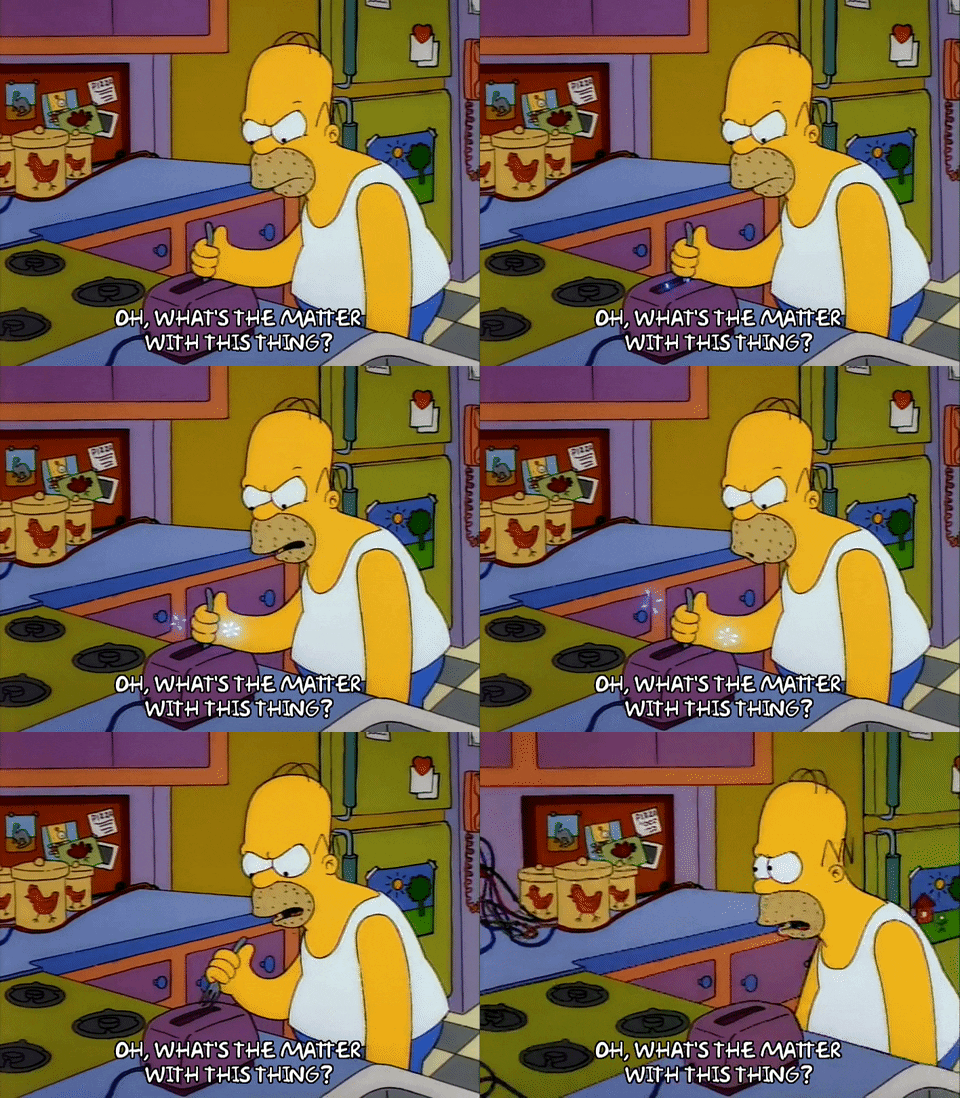
There’s a moment, somewhere after 30, when you realize you are no longer looking for “the spark.” Not because you’ve become cynical, but because the spark, in retrospect, was often an early warning sign. Like that faint burning smell in the kitchen that later turns out to be the toaster actively trying to kill you.
For most of our lives, love was sold to us as an event. Something that happens to you. Preferably suddenly, preferably against your will, preferably accompanied by a soundtrack. Love was passion, intensity, longing. Love was losing sleep and pretending you didn’t need to eat. Love was mistaking anxiety for depth and confusion for mystery.
And then you turn 30, and no one hands you the updated manual.
Instead, you notice small, unsexy shifts. You meet someone interesting and think, Yes, but how do they handle conflict? You feel chemistry and immediately wonder if it’s trauma-based. You start valuing calm, which is deeply inconvenient because calm has terrible PR. No one ever wrote a poem about a man who owns a functional vacuum cleaner and uses it. No one wrote a ballad about emotional availability. There’s no movie called He Remembered I Was Lactose Intolerant.
The myth doesn’t collapse all at once. It erodes. You see friends fall in and out of love with increasing efficiency. Breakups become quieter, more polite, almost administrative—you start ending relationships the way you’d cancel a gym membership.

“It’s not working” replaces “I can’t live without you,” which is progress, but emotionally less cinematic. Even your own heartbreaks start arriving with bullet points and conclusions. Like a very sad PowerPoint presentation.
What no one tells you is that love after 30 isn’t worse. It’s just less symbolic. It stops standing in for everything else.
In your twenties, love was identity. It answered questions you didn’t know how to ask: Who am I? Am I desirable? Am I chosen? Love was proof of worth. After 30, love loses that job. You already know who you are, roughly. You’ve been chosen and unchosen enough times to stop treating it as a verdict. Love becomes smaller, more specific—and therefore more real.
You’re not less romantic; you’re just less willing to confuse intensity with meaning. You’ve learned that longing can exist without compatibility, and that desire does not automatically imply safety. You’ve learned that wanting someone very badly does not mean wanting the life that comes with them. You've learned, in short, that the butterflies in your stomach might just be a passing feeling—and not necessarily a grand sign about your destiny.
There’s a quiet relief in this, even if it doesn’t photograph well.
Losing the myth of love doesn’t mean losing love. It means losing the fantasy version that required you to disappear inside it. What replaces it isn’t fireworks, but orientation. A sense of direction. A calmer question: Does this make my life better?
Which is not a very romantic question. But it is a surprisingly loving one.
And maybe that’s the first real shift after 30: love stops being something you fall into, and starts being something you can actually stand in, without losing your balance.