


When I was a broke university student in Milan, occasionally word would spread—whispers of a date, a place, something happening. The details were always vague, almost conspiratorial. The only certainty: Piazza Leonardo da Vinci, the big square opposite the Politecnico. Show up on the right night and you’d stumble into the coolest, cheapest party in town: hundreds of students sprawled across benches with plastic bags full of cheap beer, improvised sound systems, acoustic guitars battling against the noise, everyone talking at once.

It was glorious.The city was our living room for a few hours. No bouncers, no cover charge, no overpriced cocktails with names that sound like sex acts you need a manual for.
I thought it was an Italian thing—you know, like tax evasion and arguing about pasta. Turns out, it was imported from Spain.
It’s called botellón—literally “big bottle,” because Spanish is hilariously literal sometimes—and it’s Spain’s accidental genius for solving the problem of being young, broke, and thirsty for fun and, obviously, booze. The concept is revolutionary in its simplicity: buy your drinks at the supermarket for next to nothing and claim a public space to a party.
Is it legal? Technically, no. Most cities have ordinances against it. Does anyone care? Also no. It’s tolerated the way weed is in Amsterdam—technically prohibited, practically ignored, and understood to be solving more problems than it creates. Police will show up if you’re being a complete disaster, but otherwise they’ve got better things to do than arrest 200 university students for the crime of drinking Mahou on a bench. That’s because Spain understands something too many other countries forgot: cities belong to people, not business. And sometimes the law needs to take a nap while common sense does the work.
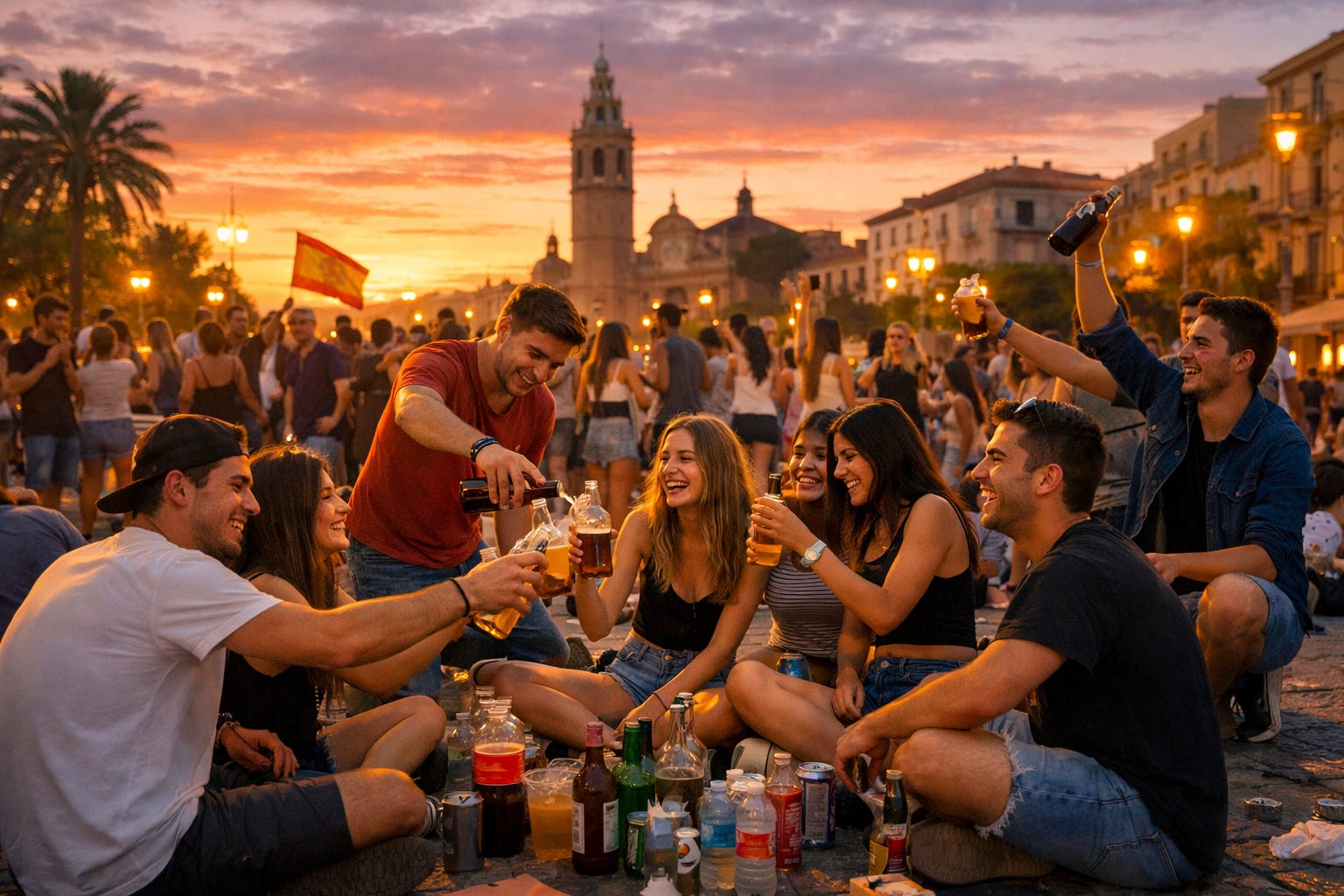
Barcelona took this principle and turned it into actual policy. The superblock system—superilles, if you want to sound fancy at dinner parties—literally redesigned entire streets to prioritize people over cars. Whole neighborhoods got converted into pedestrian zones where kids play football, old men argue over dominoes with the intensity of nuclear negotiations, and yes, students drink Estrella Damm on benches like it’s a constitutional right.
It’s not about traffic flow. It’s about admitting that maybe, just maybe, humans are more important than Seta Ibizas.
Contrast that with most other places, where public space is either privatized or policed into joyless submission. In the US, you can’t drink outside unless it’s inside a carefully designated “beer garden” that costs more than your student loan payment. Sit anywhere too long without buying something and security will materialize like you’ve triggered some sort of capitalism alarm. The message is clear: if you’re not spending money, you’re loitering. And loitering is for criminals and pigeons.
Spain said joder, no. Public space is public. The mess—and yes, there’s mess, let’s not romanticize the morning-after bottle graveyards—is the price of freedom. It’s a price Spanish cities seem willing to pay, because the alternative is worse: sterile plazas where nobody gathers, streets designed for cars that hate you, young people with nowhere to go but expensive bars where a gin and tonic costs more than a kidney on the black market.
Botellón is dying out in some places now—gentrification, noise complaints, the usual killjoys—but what it represents still matters. It is a reminder that cities are living organisms, not open-air malls. That sometimes the best urban planning is admitting you have no idea what you’re doing and just letting people figure it out themselves.
I haven’t been to one in years. But I miss those Milan nights—the cheap beer named “beer” sold at Lidl (I kid you not), the terrible guitar covers of Wonderwall, the strangers who became friends because you were all sitting on the same cold stone bench wondering if this was what freedom felt like.
It wasn’t sophisticated. It definitely wasn’t Instagram-worthy. Someone always threw up in a fountain.
But it was ours.