


Two days ago was Europe Day.
You didn’t know that.
Don’t feel bad — neither did most of Europe.
Compare this to the 4th of July, which Americans celebrate with the energy of people who have been waiting their entire lives for an excuse to eat a hotdog while watching something explode.
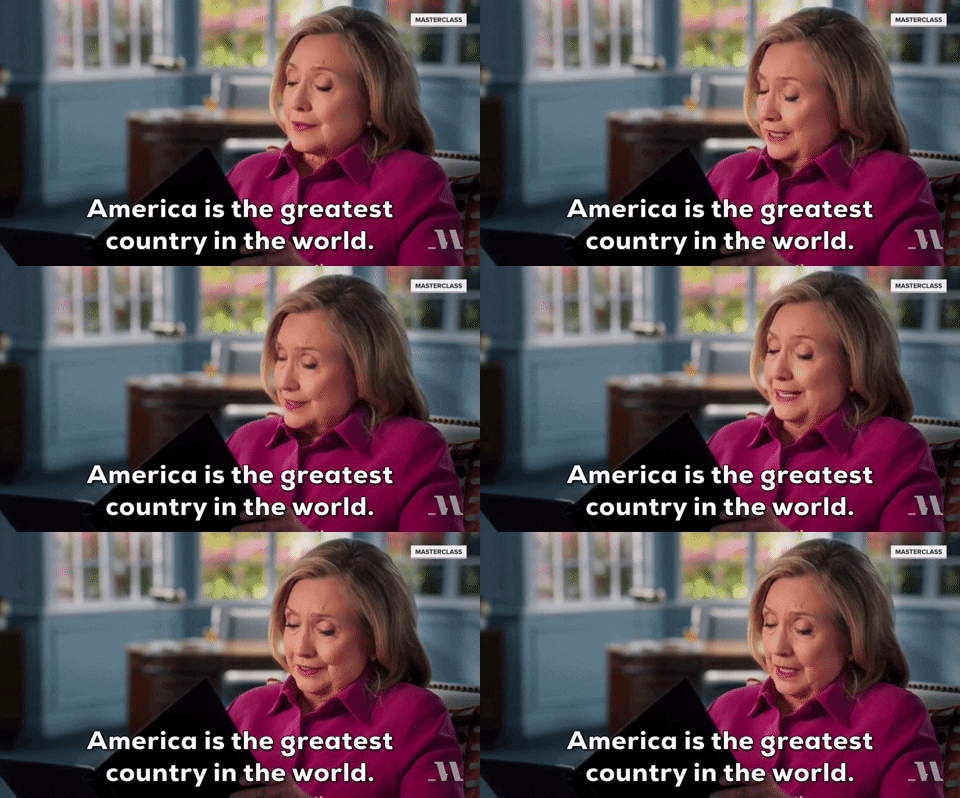
Americans disagree on almost everything right now — politics, vaccines, the shape of the earth — but the one thing they reliably agree on is this: America is great. Possibly the greatest. Probably the greatest. Definitely the greatest. The phrase “the greatest country in the world” is delivered in American movies and media with the straight-faced conviction usually reserved for papal declarations and Google Maps.
The 4th of July is not a public holiday. It is a religion. There are fireworks. There are parades. There is a national mood.
Europe had a Tuesday (well, it was Saturday actually, but you get my point).
To be fair, Europe has a branding problem that starts at the source documents.
The Declaration of Independence opens with: “We hold these truths to be self-evident, that all men are created equal, that they are endowed by their Creator with certain unalienable Rights, that among these are Life, Liberty and the pursuit of Happiness.”
Excellent copy. Whoever wrote this understood that you need to give people something to put on a flag.
Europe Day, meanwhile, commemorates the Schuman Declaration — a proposal made on 9 May 1950 by French Foreign Minister Robert Schuman, who suggested that France and Germany pool their coal and steel production under a shared authority. The reasoning was elegant: if you share the same industrial base, it’s considerably harder to go to war with each other. This proposal is the foundation of what eventually became the European Union.
The Schuman Declaration contains the following line: “Europe will not be made all at once, or according to a single plan. It will be built through concrete achievements which first create a de facto solidarity.”
This is a project management brief.
A very good project management brief — accurate, honest, and as it turned out, prophetic — but not exactly something you embroider on a cushion. Nobody has ever shouted DE FACTO SOLIDARITY at a sporting event. There are no fireworks that spell out “concrete achievements.” You see where the EU’s image as cluster of very boring technocrats comes from.
Which is a shame. Because what Europe has actually done in 76 years is really quite extraordinary.
The longest period of peace in the continent’s recorded history. Before the EU, Western Europe had been doing large-scale war roughly every generation for about a thousand years. Since the project began — nothing. This is not an accident. It is, as Schuman correctly identified, the result of building shared interests until war becomes economically inconvenient and politically absurd. Not glamorous. Functional, which in European policy is considered high praise.
The largest single market and trade bloc in the world — bigger than the US, bigger than China — built out of twenty-seven countries with twenty-four official languages and extremely strong opinions about each other’s food (especially in Italy—see below).
How to Start a Fight in Italy (Just Mention Carbonara)

If you want to start a fight in Italy, don’t mention politics. Just ask someone how to make carbonara.
And freedom of movement: the right of every EU citizen to live, work, study, or retire in any of those twenty-seven countries without asking anyone’s permission. This is so remarkable that most Europeans have completely stopped noticing it.
Except, as it happens, the British. Who had it, voted to give it up, and are now discovering — with each new form, each new visa application, each new bewildering piece of administrative theatre — exactly what it was they had. Nothing sharpens appreciation quite like absence.
Europe is, I think, the goofy uncle. You know the one. High-waisted jeans. Comb-over. No discernible personal charisma. At family gatherings he talks about regulatory frameworks and harmonised standards while everyone else is on their third glass of wine and arguing about something much more interesting.
Then someone mentions music.
Turns out he’s had a heavy metal band for thirty years. Writes all the lyrics himself. Plays bass.
The band is called De Facto Solidarity.