


Across the anglophone world, the moral consensus on infidelity is settled, firm, and — if anything — getting firmer. Nearly nine in ten Americans say it’s morally wrong. Similar numbers in Australia and the UK. Canadians sit slightly lower, but still strongly in agreement. The moral consensus on cheating is about as close to universal as these things get.
Cross the Channel, and it dissolves.
In France, barely half agree. In Germany, a little more than half. Across Europe, the response to the question is less a verdict than a shrug.
Researchers have noted this without further comment. They are, presumably, professionals.

The instinct is to file this under of course they did and move on. The French. Very sophisticated. Very comfortable with desire. Famously unconcerned with guilt as a concept. This is the take that has lived in every British newspaper column since approximately 1987, and it lets us off the hook for thinking about it further.
But that instinct is lazy. Because the interesting thing isn’t the 47%. It’s what’s underneath it.
A separate European survey found that 54% of French people believe you can love your partner while being unfaithful to them.
Sit with that for a moment.
Not: infidelity is fine. Not: do what you want. But: love and fidelity are not the same thing. You can have one without the other. They are separable categories.
In most of the Anglophone moral framework, this is about as coherent as announcing you've quit smoking between cigarettes. Fidelity is the proof of love. To cheat is to reveal that you never really loved them — or not enough. The whole architecture of how we talk about betrayal rests on this equivalence. He cheated, so clearly he didn’t love her. She cheated, so clearly the marriage was already over. It’s not a conclusion we reach. It’s the premise we start from.
France, apparently, disagrees. And has for a while.
Choderlos de Laclos published Les Liaisons Dangereuses in 1782.
You probably know it — either from the novel itself, or from the John Malkovich film, or from the Cruel Intentions era of your adolescence, which honestly holds up.
Two French aristocrats, the Marquise de Merteuil and the Vicomte de Valmont, play elaborate games with desire. They seduce, manipulate, and destroy people as an intellectual sport. It ends very badly. For everyone.
It is not a celebration of infidelity.
But it is something more interesting: a text from 1782 in which desire is treated as a psychological and philosophical phenomenon worth examining carefully, without a moral verdict stapled to every page. Laclos wasn’t writing a cautionary tale. He was dissecting something. Holding it up to the light. The tone is cool and precise, almost clinical — as if desire were a subject deserving serious intellectual attention rather than a sin to be judged.
Not too long before, Samuel Richardson had written Clarissa on the other side of the Channel. A 1,500-page novel — and I cannot stress enough how much Richardson wanted you to understand this — in which a woman is destroyed by a man who wants her, and the entire moral architecture of the book is about virtue, sin, and judgment. The predator is damned. The victim is martyred. The lesson is obvious. For context: the Bible is approximately 800,000 words. Clarissa is 969,000. Richardson really committed to the point.
You are not expected to come away from it thinking about desire. You are expected to come away knowing what is right.

Two novels. Two neighbouring countries. Two completely different questions being asked about the same human experience.
The data does complicate the easy myth of French exceptionalism, though — in a useful direction.
France isn’t actually the most unfaithful country in Europe. Italy is, at 45% of people having been unfaithful. Germany and Belgium are also ahead. The country that moralises infidelity the least is not, it turns out, the country that practises it the most.
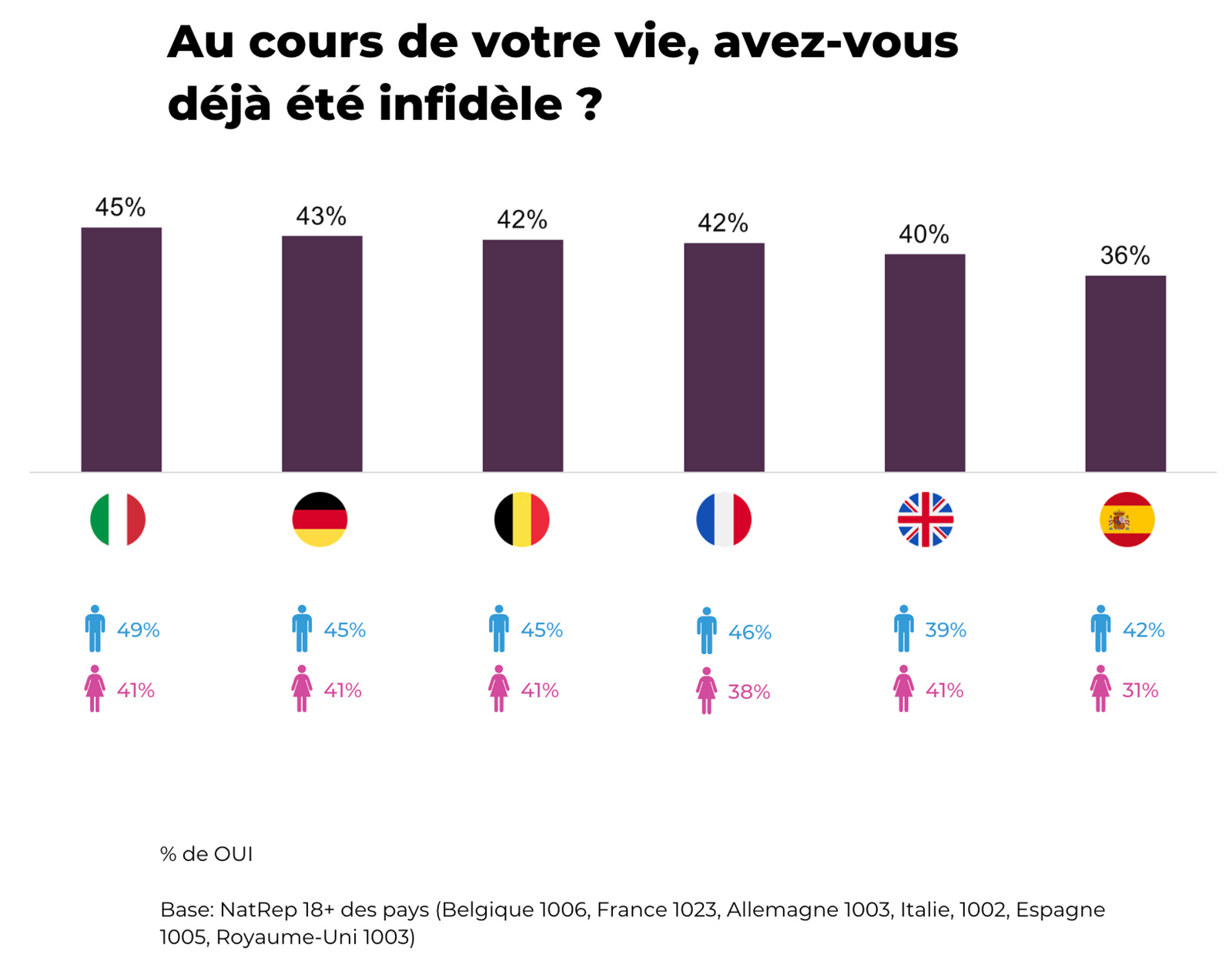
Have you been ever been unfaithful? Survey data from 2022. Source.
And the British — morally closest to Americans in this survey, most likely to regret their infidelity (48% do) — don’t appear to cheat less than anyone else as a result. They just feel worse about it.
Do the thing. Feel terrible. Never discuss it. Which is, honestly, a very British solution to the problem.

But here’s the question the data keeps raising: what is the moral condemnation actually for?
If the answer is preventing the behaviour, the numbers clearly don’t support it. Even in countries with Inquisition-level attitudes to cheating, at least a quarter of people still do. Moral certainty and actual behaviour are not, it turns out, on speaking terms.
What the condemnation might be doing instead is foreclosing a conversation.
If infidelity is simply wrong — morally unacceptable, full stop, case closed — then there’s nothing left to examine. No question about what desire actually is, or why it doesn’t always map neatly onto love, or why the thing that starts as electric between two people becomes comfortable and then routine and then, for some people, invisible. No question about whether fidelity-as-ownership is a loving framework or a property framework that learned to dress better. No question about what we’re actually asking of people when we ask them to feel desire exclusively for one person, indefinitely, in perpetuity, while life and time do what they do.
France is still asking those questions. Or at least, fewer French people have stopped asking them.
The French answer isn’t obviously better. Laclos’s characters end up destroyed. The 54% who separate love from fidelity are not, I suspect, universally happy. Desire treated as a philosophical category rather than a moral one can go in cold and ruthless directions — the Marquise de Merteuil understood that better than anyone, and she still lost.
But the question is more honest.
Because the 84% consensus doesn’t mean 84% of people are faithful. It means 84% of people have agreed to feel bad about something that — evidence suggests — a meaningful portion of them will do anyway, and to call that feeling bad a form of moral superiority.
Which is not the same thing.
I reread Liaisons Dangereuses last year, and what struck me again was how contemporary it feels. Not the setting. The psychology. The gap between what people say about love and what they do with it. The way desire refuses to stay inside the container we’ve built for it. The discomfort that causes, and how quickly we reach for a moral category to make the discomfort stop.
Laclos wrote it in 1782. We’re still having the same argument.
Which suggests, possibly, that the problem isn’t moral failure.
It’s that the container was always the wrong shape.
Sources:
Pew Research Center, Global Views on Morality (2014, fieldwork 2013): https://www.pewresearch.org/short-reads/2014/01/14/french-more-accepting-of-infidelity-than-people-in-other-countries/
Pew Research Center, Global Attitudes Survey (March 2026, fieldwork 2025): https://www.pewresearch.org/religion/2026/03/05/in-25-country-survey-americans-especially-likely-to-view-fellow-citizens-as-morally-bad/
Gleeden / YouGov, Observatoire Européen de l’Infidélité (June 2022): https://lareclame.fr/observatoire-infidelite-europe-gleeden-265812
YouGov UK, Nearly a fifth have cheated on a partner (2015): https://yougov.co.uk/society/articles/12404-one-five-british-adults-admit-affair
Relationships Australia, Infidelity (January 2018): https://www.relationships.org.au/document/january-2018-infidelity/
World Population Review, Infidelity Rates by Country: https://worldpopulationreview.com/country-rankings/infidelity-rates-by-country
Gallup, Values and Beliefs Survey (May 2025): https://news.gallup.com/poll/692801/adultery-cloning-seen-immoral-behaviors.aspx
YaleGlobal, World Agrees: Adultery, While Prevalent, Is Wrong: https://archive-yaleglobal.yale.edu/content/world-agrees-adultery-while-prevalent-wrong